
Consumer Information
Accreditation
The College of Education at Western New Mexico University reports annually to our national accrediting bodies. The Council for the Accreditation of Educator Preparation (CAEP) requires data on 4 impact measures. These measures are used to provide information to the general public on our program outcomes and candidates and program completers impact on P-12 learning. The National Association for the Education of Young Children (NAEYC) also requires data on specific outcomes. These data are provided here.
Accredited Initial Licensure Programs:
- Career and Technical Teacher Education
- Early Childhood Education
- Elementary Education
- Physical Education
- Secondary Education
- Special Education
Advanced Programs – Accreditation Review Spring 2022
- Educational Leadership
- Reading (MAT)
- School Counseling
Accredited Teaching Fields:
- Art – Elementary
- Bilingual Education
- Business Marketing
- Classical Language – Spanish
- General Science – Elementary
- Health Science Education
- Language Arts
- Mathematics
- Psychology
- Reading
- Science Education
- Social Studies
- TESOL
Approved Programs:
- Elementary Education
- Physical Education
- Reading (MAT)
- Secondary Education
- Special Education
- Bilingual Education
- TESOL
- Educational Leadership
CAEP Measures of Program Impact
Initial Programs
The College of Education is committed to assessing the impact and effectiveness of program completers in P–12 educational settings. Measure 1 focuses on completer effectiveness and impact on student learning after program completion and employment in professional education positions.
For Academic Year 2024–2025, the College of Education is in the process of collecting and analyzing completer impact and effectiveness data from school district partners, employers, and other available sources. Data collection efforts include employer feedback, completer follow-up activities, and collaboration with state and local education agencies.
Updated Measure 1 results will be posted upon receipt, analysis, and verification of the data. The College of Education anticipates publishing updated completer impact and effectiveness findings by September 30, 2026.
The College remains committed to continuous improvement and to monitoring the effectiveness of its graduates in supporting P–12 student learning and development.
Initial Licensure
The EPP has MOUs with districts from across the state of New Mexico and in states across the country. Current MOUs are established with numerous school districts throughout New Mexico and provide opportunities for clinical experiences, stakeholder engagement, and continuous program improvement.
Current MOU’s are established with the following districts in New Mexico:
- Silver Consolidated School District
- Cobre Consolidated School District
- Deming Public Schools
- Albuquerque Public Schools
- Rio Rancho Public Schools
- Socorro Consolidated Schools
- Animas Public Schools
- Lordsburg Municipal Schools
- Truth or Consequences Municipal Schools
- Hatch Valley Public Schools
- Las Cruces Public Schools
- Farmington Municipal Schools
- Aztec Municipal School District
Advisory meetings are scheduled once each semester, with representatives from partner districts invited to attend, including administrators, teachers, candidates, and program completers. These meetings provide opportunities for stakeholders to discuss program strengths, workforce needs, and recommendations for continuous improvement.
Due to a cyber security incident, the employer survey results for FY 25 are not recoverable. FY 26 data will be posted by September 30, 2026
Initial Programs
The EPP uses Skyfactor Benchworks Teacher Education Survey to assess completer satisfaction and preparation:
The College of Education evaluates candidate competency through successful completion of coursework, clinical experiences, key assessments, licensure requirements, and program completion standards. Candidate competency is assessed using multiple measures, including performance-based assessments, supervised clinical experiences, and candidate perceptions of preparedness for professional practice.
Program Completion and Clinical Experiences
Title II reporting data for Academic Year 2024–2025 indicate that Western New Mexico University prepared and graduated educator candidates across both traditional and alternative pathways. (Title II Program Report 4_30_2026 5_30_58 PM)
A total of 328 candidates completed educator preparation programs during the academic year, including:
- 275 completers from traditional programs.
- 53 completers from alternative licensure programs.
Candidates completed extensive clinical experiences prior to program completion. Traditional program candidates participated in supervised clinical experiences requiring 120 hours of pre-student-teaching fieldwork and 680 hours of student teaching. The College of Education supervised 253 candidates in clinical placements with support from 292 cooperating teachers and 14 full-time faculty supervisors. (Title II Program Report 4_30_2026 5_30_58 PM)
Exit Teaching Event Assessment
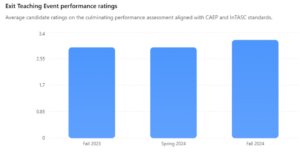
Candidate competency was further demonstrated through performance on the Exit Teaching Event, a culminating performance-based assessment aligned with CAEP Standard 1 and the Interstate Teacher Assessment and Support Consortium (InTASC) Standards. The assessment evaluates candidate performance in the areas of Planning, Instruction, Assessment, and Reflection.
During the reporting period, 195 candidate assessments were completed. Candidates achieved an overall average performance rating of 2.99 on a 4-point scale. Evidence_1_Exit_Teaching_Event_Data_and_Trends.xlsx
Average assessment ratings included:
| Assessment Period | Average Rating |
| Fall 2023 | 2.91 |
| Spring 2024 | 2.91 |
| Fall 2024 | 3.15 |
| Overall Average | 2.99 |
Results indicate that candidates demonstrated proficiency in instructional planning, effective teaching practices, assessment of student learning, and reflective professional practice prior to program completion.
Candidate Preparedness at Program Completion
Results from the New Mexico Educator Preparation Program Year-End Survey indicate that candidates perceived themselves as well prepared for entry into the profession and confident in their ability to support P–12 student learning. (WNMU End of Year Survey Report (1).pdf)
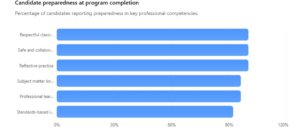
Survey respondents reported strong preparation in key professional competencies:
- 96% reported preparation in subject matter knowledge.
- 92% reported preparation in standards-based instructional design.
- 96% reported preparation in applying professional learning to support students.
- 100% reported preparation in creating respectful classroom environments.
- 100% reported preparation in creating safe and collaborative learning environments.
- 100% reported preparation in reflective professional practice.
These findings indicate that candidates successfully demonstrated the knowledge, skills, and professional dispositions expected of program completers and were prepared to enter the profession as effective educators.
Initial Programs
The College of Education prepares candidates for employment in public, private, and charter school settings through clinically rich educator preparation programs aligned with state licensure requirements.
Title II data indicate that 328 candidates completed educator preparation programs during Academic Year 2024–2025 and became eligible for employment in positions aligned with their licensure areas. Completers were prepared in high-need fields including Early Childhood Education, Elementary Education, Special Education, Physical Education, Reading, Mathematics, and Health Education. (Title II Program Report 4_30_2026 5_30_58 PM)
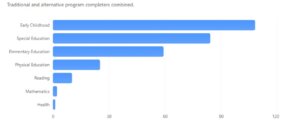
Program completers represented the following primary preparation areas:
- Early Childhood Education: 108 completers (97 traditional, 11 alternative)
- Elementary Education: 59 completers (43 traditional, 16 alternative)
- Special Education: 84 completers (72 traditional, 12 alternative)
- Physical Education: 25 completers
- Reading: 10 completers
- Mathematics: 2 completers
- Health Education: 1 completer
In addition, 96% of survey respondents reported that they intended to accept a position if offered by their clinical placement district, demonstrating strong alignment between program preparation and workforce participation. (WNMU End of Year Survey Report (1).pdf)
The College of Education continues to monitor completer employment outcomes through state reporting systems, graduate follow-up activities, and Title II reporting processes.
Program completers represented the following primary preparation areas:
- Early Childhood Education: 108 completers (97 traditional, 11 alternative)
- Elementary Education: 59 completers (43 traditional, 16 alternative)
- Special Education: 84 completers (72 traditional, 12 alternative)
- Physical Education: 25 completers
- Reading: 10 completers
- Mathematics: 2 completers
- Health Education: 1 completer
In addition, 96% of survey respondents reported that they intended to accept a position if offered by their clinical placement district, demonstrating strong alignment between program preparation and workforce participation. (WNMU End of Year Survey Report (1).pdf)
The College of Education continues to monitor completer employment outcomes through state reporting systems, graduate follow-up activities, and Title II reporting processes.
Completers by Major Licensure Area
Advanced Programs
The primary advanced programs offered by WNMU, with substantial graduates to track are Education Leadership and Reading. 100% of our educational leadership and reading graduates are able to move into leadership positions with their individual districts. This data is based on report by graduates to the Program Leads in each of these programs.
Early Childhood Programs
The A.A. Early Childhood Education and Family Support at Western New Mexico is accredited by the Commission on the Accreditation of Early Childhood Higher Education Programs of the National Association for the Education of Young Children. The current accreditation term runs from July 2024 through December 2026.
NAEYC accreditation certificates and decision letters
1. WNMU ECED AA NAEYC Accreditation Certificate
2. WNMU ECED AA NAEYC Commission Decision Letter
3. WNMU ECED BS NAEYC Accreditation Certificate
4. WNMU ECED BS NAEYC Commission Decision Letter
NAEYC Annual Reports & Data
All programs are required to select at least one of the following outcome measures on which to report. (Institutions submitting multiple programs in a single Annual Report may select the same or a different measure for each program; a separate chart must be submitted for each program.)
Outcome Measure #1: The Number of Program Completers
Outcome Measure #2: The Program Completion Rate
Outcome Measure #3: Institutional Selected Data
Title II Reports and Retention Rates
Traditional Programs
- Title II Traditional Program Report 4_26_2024 3_54_36 PM (1) for AY 22-23
- TRAD_NM_2023_4535 (Pass rate)_Western New Mexico University
Alternative Programs